
18 August 2026
AI & Energy: The New Architecture of Emerging Economies
Kathmandu, Nepal
Technology & AIAI is pushing electricity demand up sharply just as emerging economies decide how to build their grids. Brian Wong, Professor at the University of Hong Kong and Bibek Raj Kandel, Fellow at Asia Global Institute (AGI) on what that means for Nepal - energy-rich, capital-scarce, and deciding whether clean power becomes an industrial asset or just an export.
Two transitions are usually debated in separate rooms. Artificial intelligence is reorganising what work, capital and expertise are worth. The energy transition is reorganising how economies are powered and what they can afford to build. They have now collided: training and running AI systems draws electricity at industrial scale, and the International Energy Agency (IEA) expects demand from data centres to roughly double by 2030.
For emerging economies, like Nepal, that collision arrives as both an opening and a threat. Computing capacity is increasingly located wherever power is abundant, cheap and clean, which puts energy-rich developing countries on the map for infrastructure that until recently concentrated in a handful of advanced markets. At the same time, AI raises the capital and skill intensity of catching up, narrowing the manufacturing-led ladder that earlier industrialisers climbed.
Why this lands hard in Nepal
Nepal presents an especially clear version of this challenge. Its grid is overwhelmingly hydroelectric. During the monsoon, it produces surplus power for export and during the dry season, it still imports electricity. Meanwhile, one of its most dependable exports has long been its workforce.
AI-driven electricity demand changes the calculation. The question is no longer simply how much power Nepal can generate, but what it can build around that power. Can renewable electricity anchor data infrastructure, digital services, advanced industry, and higher-value employment at home? Or will Nepal export power while importing the intelligence, platforms, and capabilities built with it elsewhere?
Questions on the table
Where computing capacity actually lands, and what makes a country a credible host for it beyond cheap electricity — grid reliability, connectivity, water, land, and legal certainty.
Whether exporting power while importing intelligence is a viable development strategy or a new form of dependence.
What AI does to the labour-and-remittance model much of South Asia currently runs on, and to the jobs young graduates are preparing for.
Which parts of the state have to move first: grid planning, regulation, data and privacy rules, or the education pipeline.
Speakers
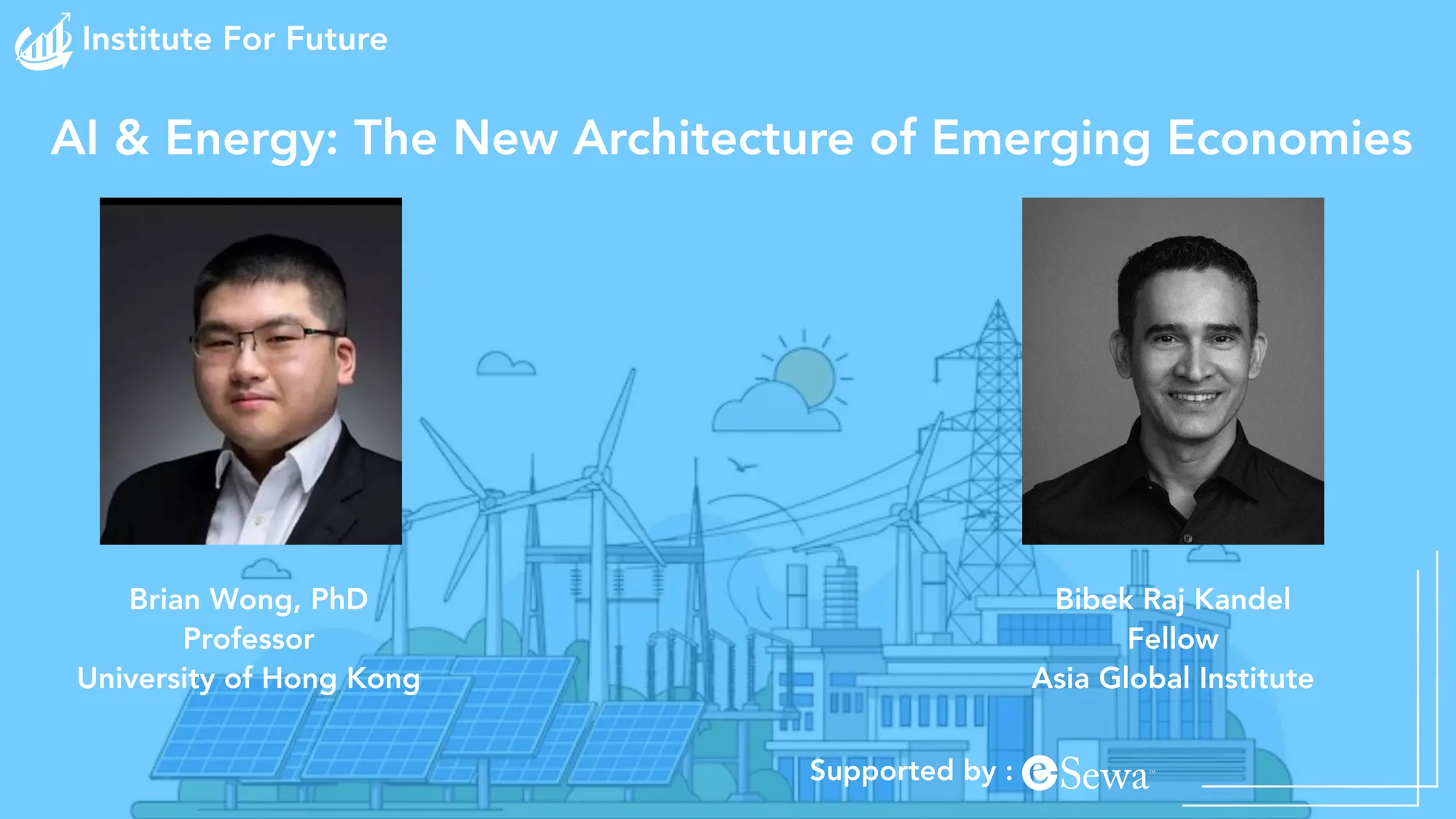
Brian Wong, PhD - Professor, University of Hong Kong
Bibek Raj Kandel - Fellow, Asia Global Institute
Taking part
The session is invitation only for those working in policy, industry, finance and academia, and to students weighing where this field is going. It is aimed at people who want the argument rather than a briefing.
To confirm a place or ask about the programme, write to info@institutefuture.org.
Supported by eSewa.